What makes a trend suddenly take off?
Complex contagion theory is when adopting a new behavior or product takes multiple exposures — not just one.
Tipping Points
In the early 2000s, Malcolm Gladwell’s book
The Tipping Point described what catalyzes a trend taking off. Today, we are not only able to describe trends, but apply data to forecast how likely it is for a product to become the next big thing.An Example from The Tipping Point


In the Hush Puppies story, shoes didn’t spread instantly: it took seeing them again and again, within tight social circles, before people caught on.
We’ll walk through the key social ingredients Malcolm Gladwell says are needed for an “epidemic” like this to happen—and show how changing each ingredient impacts adoption to make the produce take off or fizzle out.
1
Early
AdoptersSome people are especially tuned in to what’s new or different, and willing to give it a try. In our model, they’re more likely to be the first adopters. In the Hush Puppies story, these were East Village hipsters who tried something weird, making it just a little less weird for everyone else.
1
Early Adopters: Necessary but Not Sufficient
In this example, the darker the node, the higher likelihood of being early adopters, while the thick black circles show actual early adoption happening. Bold black edges show connections of the initial adopters. Note no node is exposed to multiple initial adopters.
Why Trends Often Fizzle in Sparse Networks
When a network is random and connections are sparse, even having early adopters isn’t enough to ignite widespread change. Most people won’t encounter the new idea from more than one neighbor, so the social “push” needed for complex contagion just doesn’t happen. Most trends stall with a handful of adopters—it’s rare for an idea to get enough multiple exposures to catch on more broadly.
2
Community Structure
Where Trends Are Born
Trends don’t start everywhere—they start in tight communities where people are closely connected. In 1994, it was young NYC hipsters in the East Village who noticed the odd, forgotten Hush Puppies shoes and began wearing them. Their dense network meant the style had the potential to quickly “bounce around” within the group.
2
Community Structure: Social Graph of Young NYC Hipsters
People who live close by, look alike, and think similarly are much more likely to be connected. “Friends of friends” often become friends. In this example, a tightly connected 16-person East Village circle shows very high "clustering" - meaning each hipster has many mutual friends. Note how many nodes are exposed to both initial adopters.
Why Trends Might Still Fizzle in Dense Networks
Dense, tight-knit communities create the potential for trends to catch on. High clustering means you often encounter the same idea multiple times—through a friend, and a friend’s friend—making complex contagion possible.
But there’s still a missing ingredient.
Even with repeated exposures, an idea or behavior still needs to be noticed and remembered to actually spread. Just like a disease must be infectious enough to jump from person to person, a trend needs to stand out, be memorable, or feel relevant before people adopt it—even when they’ve seen it more than once.3
Stickiness
Why Some Ideas Spread
Not every new thing gets remembered. The concept of stickiness is about how much an idea, product, or look stands out—and how long people talk about it after seeing it. Hush Puppies were so out of place that when someone saw them, they remembered, talked, and thought about them again. In our model, stickier ideas spread more easily, even if people need multiple exposures.
3
Stickiness in Action: Not Everyone Adopts
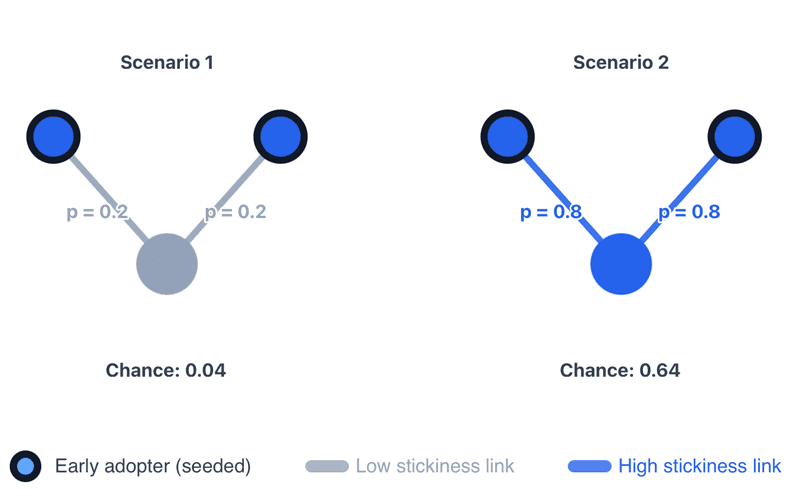
Dense community structure enables complex contagion by providing multiple exposures, but stickiness determines whether an idea is noticed and remembered.
In our model, two early adopters could spread the idea to a non-adopter via two links with different stickiness probabilities (shown). Adoption requires a minimum threshold to be met.
The top network has low stickiness (0.2), resulting in a 4% chance of adoption.
The bottom network has high stickiness (0.8), resulting in a 64%chance of adoption
The Echo Chamber: Success in a Bubble
With initial adopters, a tight-knit community, and a sticky idea, a trend can completely saturate its local group. This creates an "echo chamber" where the idea seems universally popular.
But this local success often hits an invisible wall, failing to spread to the wider world. But there’s still a missing ingredient.
4
Connectors
Bridges Between Worlds
Some people aren’t just well connected—they bridge groups. These connectors link the hipsters to the fashion world, letting the trend jump into new circles. In our model, connectors are the “wide bridge” that allows the epidemic to escape its original community.
4
Connectors: The Missing Links
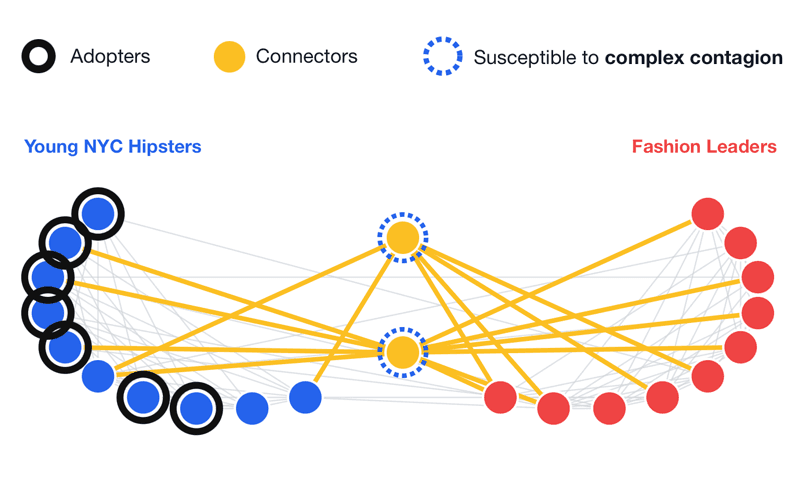
A trend can catch fire inside a dense community, but to leap farther it needs connectors, people embedded in multiple circles. Hipster adopters (black ring) make those connectors susceptible, ready to ferry the idea to Fashion Leaders.
From Steady Spread to Sudden Surge
Connectors play a critical role in moving an idea beyond its birthplace. With their help, social contagion spreads steadily, turning isolated bubbles into a broader current. But as powerful as connectors are, this kind of spread is often gradual, more like a slow burn than a wildfire. To trigger a true tipping point, a sudden, explosive surge in adoption, one more vital ingredient is needed.
5
Influencers
Reaching the Masses
At the tipping point, influencers (like fashion leaders) with huge reach can broadcast trends far and wide. In our model, they’re highly connected nodes (think about a "hub" node with many "spoke" links) who can rapidly spread an idea to regular people, turning a local fad into a full-blown epidemic.
5
Influencers: At the Tipping Point
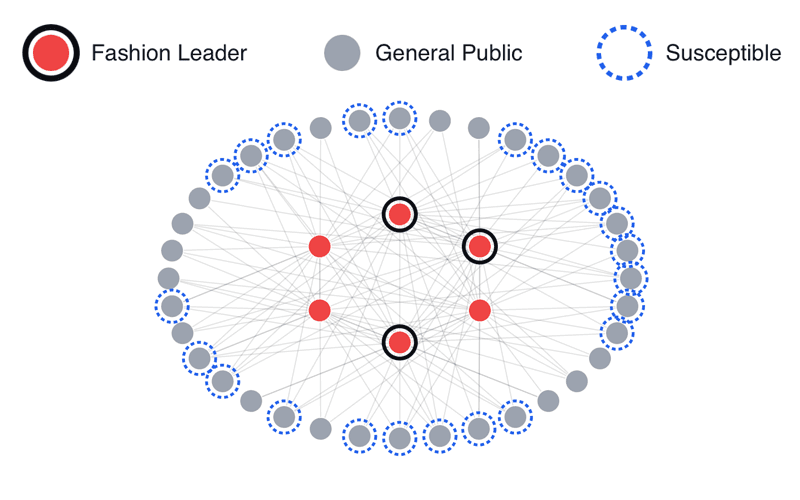
A small core of fashion leaders (center) not only reinforce each other within their own community but also cast a wide net into the wider public. As the general public is repeatedly exposed to fashion leaders wearing hush puppies, or using them on runways, many of them may choose to adopt the behavior.
From this point on, it is also helpful to think about patterns that repeat themselves. The influencers may spread a product or idea into multiple dense communities, at which point the product can spread within these communities, before the connectors in these communities bridge the product yet further into new communities.
Ingredients for a
Tipping Point:Early Adopters
Community Structure
Stickiness
Connectors
Influencers
Bummer! Our simulator works on desktop size devices only.
Please come back on a larger size device!What makes a trend suddenly take off?
Complex contagion theory is when adopting a new behavior or product takes multiple exposures — not just one.
Tipping Points
In the early 2000s, Malcolm Gladwell’s book
The Tipping Point described what catalyzes a trend taking off. Today, we are not only able to describe trends, but apply data to forecast how likely it is for a product to become the next big thing.An Example from The Tipping Point
In the Hush Puppies story, shoes didn’t spread instantly: it took seeing them again and again, within tight social circles, before people caught on.
We’ll walk through the key social ingredients Malcolm Gladwell says are needed for an “epidemic” like this to happen—and show how changing each ingredient impacts adoption to make the produce take off or fizzle out.
1
Early
AdoptersSome people are especially tuned in to what’s new or different, and willing to give it a try. In our model, they’re more likely to be the first adopters. In the Hush Puppies story, these were East Village hipsters who tried something weird, making it just a little less weird for everyone else.
1
Early Adopters: Necessary but Not Sufficient
In this example, the darker the node, the higher likelihood of being early adopters, while the thick black circles show actual early adoption happening. Bold black edges show connections of the initial adopters. Note no node is exposed to multiple initial adopters.
Why Trends Often Fizzle in Sparse Networks
When a network is random and connections are sparse, even having early adopters isn’t enough to ignite widespread change. Most people won’t encounter the new idea from more than one neighbor, so the social “push” needed for complex contagion just doesn’t happen. Most trends stall with a handful of adopters—it’s rare for an idea to get enough multiple exposures to catch on more broadly.
2
Community Structure
Where Trends Are Born
Trends don’t start everywhere—they start in tight communities where people are closely connected. In 1994, it was young NYC hipsters in the East Village who noticed the odd, forgotten Hush Puppies shoes and began wearing them. Their dense network meant the style had the potential to quickly “bounce around” within the group.
2
Community Structure: Social Graph of Young NYC Hipsters
People who live close by, look alike, and think similarly are much more likely to be connected. “Friends of friends” often become friends. In this example, a tightly connected 16-person East Village circle shows very high "clustering" - meaning each hipster has many mutual friends. Note how many nodes are exposed to both initial adopters.
Why Trends Might Still Fizzle in Dense Networks
Dense, tight-knit communities create the potential for trends to catch on. High clustering means you often encounter the same idea multiple times—through a friend, and a friend’s friend—making complex contagion possible.
But there’s still a missing ingredient.
Even with repeated exposures, an idea or behavior still needs to be noticed and remembered to actually spread. Just like a disease must be infectious enough to jump from person to person, a trend needs to stand out, be memorable, or feel relevant before people adopt it—even when they’ve seen it more than once.3
Stickiness
Why Some Ideas Spread
Not every new thing gets remembered. The concept of stickiness is about how much an idea, product, or look stands out—and how long people talk about it after seeing it. Hush Puppies were so out of place that when someone saw them, they remembered, talked, and thought about them again. In our model, stickier ideas spread more easily, even if people need multiple exposures.
3
Stickiness in Action: Not Everyone Adopts
Dense community structure enables complex contagion by providing multiple exposures, but stickiness determines whether an idea is noticed and remembered.
In our model, two early adopters could spread the idea to a non-adopter via two links with different stickiness probabilities (shown). Adoption requires a minimum threshold to be met.
The top network has low stickiness (0.2), resulting in a 4% chance of adoption.
The bottom network has high stickiness (0.8), resulting in a 64%chance of adoption
The Echo Chamber: Success in a Bubble
With initial adopters, a tight-knit community, and a sticky idea, a trend can completely saturate its local group. This creates an "echo chamber" where the idea seems universally popular.
But this local success often hits an invisible wall, failing to spread to the wider world. But there’s still a missing ingredient.
4
Connectors
Bridges Between Worlds
Some people aren’t just well connected—they bridge groups. These connectors link the hipsters to the fashion world, letting the trend jump into new circles. In our model, connectors are the “wide bridge” that allows the epidemic to escape its original community.
4
Connectors: The Missing Links
A trend can catch fire inside a dense community, but to leap farther it needs connectors, people embedded in multiple circles. Hipster adopters (black ring) make those connectors susceptible, ready to ferry the idea to Fashion Leaders.
From Steady Spread to Sudden Surge
Connectors play a critical role in moving an idea beyond its birthplace. With their help, social contagion spreads steadily, turning isolated bubbles into a broader current. But as powerful as connectors are, this kind of spread is often gradual, more like a slow burn than a wildfire. To trigger a true tipping point, a sudden, explosive surge in adoption, one more vital ingredient is needed.
5
Influencers
Reaching the Masses
At the tipping point, influencers (like fashion leaders) with huge reach can broadcast trends far and wide. In our model, they’re highly connected nodes (think about a "hub" node with many "spoke" links) who can rapidly spread an idea to regular people, turning a local fad into a full-blown epidemic.
5
Influencers: At the Tipping Point
A small core of fashion leaders (center) not only reinforce each other within their own community but also cast a wide net into the wider public. As the general public is repeatedly exposed to fashion leaders wearing hush puppies, or using them on runways, many of them may choose to adopt the behavior.
From this point on, it is also helpful to think about patterns that repeat themselves. The influencers may spread a product or idea into multiple dense communities, at which point the product can spread within these communities, before the connectors in these communities bridge the product yet further into new communities.
Ingredients for a
Tipping Point:Early Adopters
Community Structure
Stickiness
Connectors
Influencers
Bummer! Our simulator works on desktop size devices only.
Please come back on a larger size device!What makes a trend suddenly take off?
Complex contagion theory is when adopting a new behavior or product takes multiple exposures — not just one.
Tipping Points
In the early 2000s, Malcolm Gladwell’s book
The Tipping Point described what catalyzes a trend taking off. Today, we are not only able to describe trends, but apply data to forecast how likely it is for a product to become the next big thing.An Example from The Tipping Point
In the Hush Puppies story, shoes didn’t spread instantly: it took seeing them again and again, within tight social circles, before people caught on.
We’ll walk through the key social ingredients Malcolm Gladwell says are needed for an “epidemic” like this to happen—and show how changing each ingredient impacts adoption to make the produce take off or fizzle out.
1
Early
AdoptersSome people are especially tuned in to what’s new or different, and willing to give it a try. In our model, they’re more likely to be the first adopters. In the Hush Puppies story, these were East Village hipsters who tried something weird, making it just a little less weird for everyone else.
1
Early Adopters: Necessary but Not Sufficient
In this example, the darker the node, the higher likelihood of being early adopters, while the thick black circles show actual early adoption happening. Bold black edges show connections of the initial adopters. Note no node is exposed to multiple initial adopters.
Why Trends Often Fizzle in Sparse Networks
When a network is random and connections are sparse, even having early adopters isn’t enough to ignite widespread change. Most people won’t encounter the new idea from more than one neighbor, so the social “push” needed for complex contagion just doesn’t happen. Most trends stall with a handful of adopters—it’s rare for an idea to get enough multiple exposures to catch on more broadly.
2
Community Structure
Where Trends Are Born
Trends don’t start everywhere—they start in tight communities where people are closely connected. In 1994, it was young NYC hipsters in the East Village who noticed the odd, forgotten Hush Puppies shoes and began wearing them. Their dense network meant the style had the potential to quickly “bounce around” within the group.
2
Community Structure: Social Graph of Young NYC Hipsters
People who live close by, look alike, and think similarly are much more likely to be connected. “Friends of friends” often become friends. In this example, a tightly connected 16-person East Village circle shows very high "clustering" - meaning each hipster has many mutual friends. Note how many nodes are exposed to both initial adopters.
Why Trends Might Still Fizzle in Dense Networks
Dense, tight-knit communities create the potential for trends to catch on. High clustering means you often encounter the same idea multiple times—through a friend, and a friend’s friend—making complex contagion possible.
But there’s still a missing ingredient.
Even with repeated exposures, an idea or behavior still needs to be noticed and remembered to actually spread. Just like a disease must be infectious enough to jump from person to person, a trend needs to stand out, be memorable, or feel relevant before people adopt it—even when they’ve seen it more than once.3
Stickiness
Why Some Ideas Spread
Not every new thing gets remembered. The concept of stickiness is about how much an idea, product, or look stands out—and how long people talk about it after seeing it. Hush Puppies were so out of place that when someone saw them, they remembered, talked, and thought about them again. In our model, stickier ideas spread more easily, even if people need multiple exposures.
3
Stickiness in Action: Not Everyone Adopts
Dense community structure enables complex contagion by providing multiple exposures, but stickiness determines whether an idea is noticed and remembered.
In our model, two early adopters could spread the idea to a non-adopter via two links with different stickiness probabilities (shown). Adoption requires a minimum threshold to be met.
The top network has low stickiness (0.2), resulting in a 4% chance of adoption.
The bottom network has high stickiness (0.8), resulting in a 64%chance of adoption
The Echo Chamber: Success in a Bubble
With initial adopters, a tight-knit community, and a sticky idea, a trend can completely saturate its local group. This creates an "echo chamber" where the idea seems universally popular.
But this local success often hits an invisible wall, failing to spread to the wider world. But there’s still a missing ingredient.
4
Connectors
Bridges Between Worlds
Some people aren’t just well connected—they bridge groups. These connectors link the hipsters to the fashion world, letting the trend jump into new circles. In our model, connectors are the “wide bridge” that allows the epidemic to escape its original community.
4
Connectors: The Missing Links
A trend can catch fire inside a dense community, but to leap farther it needs connectors, people embedded in multiple circles. Hipster adopters (black ring) make those connectors susceptible, ready to ferry the idea to Fashion Leaders.
From Steady Spread to Sudden Surge
Connectors play a critical role in moving an idea beyond its birthplace. With their help, social contagion spreads steadily, turning isolated bubbles into a broader current. But as powerful as connectors are, this kind of spread is often gradual, more like a slow burn than a wildfire. To trigger a true tipping point, a sudden, explosive surge in adoption, one more vital ingredient is needed.
5
Influencers
Reaching the Masses
At the tipping point, influencers (like fashion leaders) with huge reach can broadcast trends far and wide. In our model, they’re highly connected nodes (think about a "hub" node with many "spoke" links) who can rapidly spread an idea to regular people, turning a local fad into a full-blown epidemic.
5
Influencers: At the Tipping Point
A small core of fashion leaders (center) not only reinforce each other within their own community but also cast a wide net into the wider public. As the general public is repeatedly exposed to fashion leaders wearing hush puppies, or using them on runways, many of them may choose to adopt the behavior.
From this point on, it is also helpful to think about patterns that repeat themselves. The influencers may spread a product or idea into multiple dense communities, at which point the product can spread within these communities, before the connectors in these communities bridge the product yet further into new communities.
Ingredients for a
Tipping Point:Early Adopters
Community Structure
Stickiness
Connectors
Influencers
Bummer! Our simulator works on desktop size devices only.
Please come back on a larger size device!What makes a trend suddenly take off?
Complex contagion theory is when adopting a new behavior or product takes multiple exposures — not just one.
Tipping Points
In the early 2000s, Malcolm Gladwell’s book
The Tipping Point described what catalyzes a trend taking off. Today, we are not only able to describe trends, but apply data to forecast how likely it is for a product to become the next big thing.An Example from The Tipping Point
In the Hush Puppies story, shoes didn’t spread instantly: it took seeing them again and again, within tight social circles, before people caught on.
We’ll walk through the key social ingredients Malcolm Gladwell says are needed for an “epidemic” like this to happen—and show how changing each ingredient impacts adoption to make the produce take off or fizzle out.
1
Early
AdoptersSome people are especially tuned in to what’s new or different, and willing to give it a try. In our model, they’re more likely to be the first adopters. In the Hush Puppies story, these were East Village hipsters who tried something weird, making it just a little less weird for everyone else.
1
Early Adopters: Necessary but Not Sufficient
In this example, the darker the node, the higher likelihood of being early adopters, while the thick black circles show actual early adoption happening. Bold black edges show connections of the initial adopters. Note no node is exposed to multiple initial adopters.
Why Trends Often Fizzle in Sparse Networks
When a network is random and connections are sparse, even having early adopters isn’t enough to ignite widespread change. Most people won’t encounter the new idea from more than one neighbor, so the social “push” needed for complex contagion just doesn’t happen. Most trends stall with a handful of adopters—it’s rare for an idea to get enough multiple exposures to catch on more broadly.
2
Community Structure
Where Trends Are Born
Trends don’t start everywhere—they start in tight communities where people are closely connected. In 1994, it was young NYC hipsters in the East Village who noticed the odd, forgotten Hush Puppies shoes and began wearing them. Their dense network meant the style had the potential to quickly “bounce around” within the group.
2
Community Structure: Social Graph of Young NYC Hipsters
People who live close by, look alike, and think similarly are much more likely to be connected. “Friends of friends” often become friends. In this example, a tightly connected 16-person East Village circle shows very high "clustering" - meaning each hipster has many mutual friends. Note how many nodes are exposed to both initial adopters.
Why Trends Might Still Fizzle in Dense Networks
Dense, tight-knit communities create the potential for trends to catch on. High clustering means you often encounter the same idea multiple times—through a friend, and a friend’s friend—making complex contagion possible.
But there’s still a missing ingredient.
Even with repeated exposures, an idea or behavior still needs to be noticed and remembered to actually spread. Just like a disease must be infectious enough to jump from person to person, a trend needs to stand out, be memorable, or feel relevant before people adopt it—even when they’ve seen it more than once.3
Stickiness
Why Some Ideas Spread
Not every new thing gets remembered. The concept of stickiness is about how much an idea, product, or look stands out—and how long people talk about it after seeing it. Hush Puppies were so out of place that when someone saw them, they remembered, talked, and thought about them again. In our model, stickier ideas spread more easily, even if people need multiple exposures.
3
Stickiness in Action: Not Everyone Adopts
Dense community structure enables complex contagion by providing multiple exposures, but stickiness determines whether an idea is noticed and remembered.
In our model, two early adopters could spread the idea to a non-adopter via two links with different stickiness probabilities (shown). Adoption requires a minimum threshold to be met.
The top network has low stickiness (0.2), resulting in a 4% chance of adoption.
The bottom network has high stickiness (0.8), resulting in a 64%chance of adoption
The Echo Chamber: Success in a Bubble
With initial adopters, a tight-knit community, and a sticky idea, a trend can completely saturate its local group. This creates an "echo chamber" where the idea seems universally popular.
But this local success often hits an invisible wall, failing to spread to the wider world. But there’s still a missing ingredient.
4
Connectors
Bridges Between Worlds
Some people aren’t just well connected—they bridge groups. These connectors link the hipsters to the fashion world, letting the trend jump into new circles. In our model, connectors are the “wide bridge” that allows the epidemic to escape its original community.
4
Connectors: The Missing Links
A trend can catch fire inside a dense community, but to leap farther it needs connectors, people embedded in multiple circles. Hipster adopters (black ring) make those connectors susceptible, ready to ferry the idea to Fashion Leaders.
From Steady Spread to Sudden Surge
Connectors play a critical role in moving an idea beyond its birthplace. With their help, social contagion spreads steadily, turning isolated bubbles into a broader current. But as powerful as connectors are, this kind of spread is often gradual, more like a slow burn than a wildfire. To trigger a true tipping point, a sudden, explosive surge in adoption, one more vital ingredient is needed.
5
Influencers
Reaching the Masses
At the tipping point, influencers (like fashion leaders) with huge reach can broadcast trends far and wide. In our model, they’re highly connected nodes (think about a "hub" node with many "spoke" links) who can rapidly spread an idea to regular people, turning a local fad into a full-blown epidemic.
5
Influencers: At the Tipping Point
A small core of fashion leaders (center) not only reinforce each other within their own community but also cast a wide net into the wider public. As the general public is repeatedly exposed to fashion leaders wearing hush puppies, or using them on runways, many of them may choose to adopt the behavior.
From this point on, it is also helpful to think about patterns that repeat themselves. The influencers may spread a product or idea into multiple dense communities, at which point the product can spread within these communities, before the connectors in these communities bridge the product yet further into new communities.
Ingredients for a
Tipping Point:Early Adopters
Community Structure
Stickiness
Connectors
Influencers
Bummer! Our simulator works on desktop size devices only.
Please come back on a larger size device!
What are the catalysts for a trend's explosion?
Complex contagion theory is when adopting a new product
or behavior takes multiple exposures — not just one.Tipping Points
In the early 2000s, Malcolm Gladwell’s book The Tipping Point described what catalyzes a trend taking off. Today, we are not only able to describe trends, but apply data to forecast how likely it is for a product to become the next big thing.
An Example from
The Tipping PointIn the Hush Puppies story, shoes didn’t spread instantly: it took seeing them again and again, within tight social circles, before people caught on.
We’ll walk through the key social ingredients Malcolm Gladwell says are needed for an “epidemic” like this to happen—and show how changing each ingredient impacts adoption to make the produce take off or fizzle out.
1
Early
AdoptersSome people are especially tuned in to what’s new or different, and willing to give it a try. In our model, they’re more likely to be the first adopters. In the Hush Puppies story, these were East Village hipsters who tried something weird, making it just a little less weird for everyone else.
1
Early Adopters: Necessary but Not Sufficient
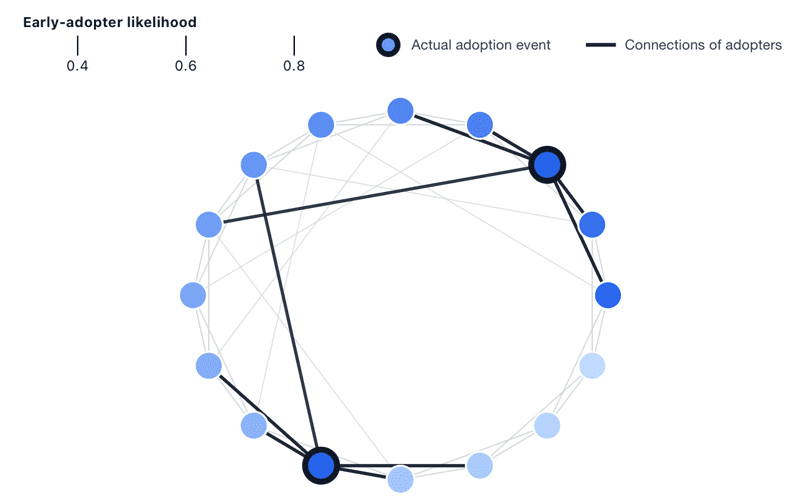
In this example, the darker the node, the higher likelihood of being early adopters, while the thick black circles show actual early adoption happening. Bold black edges show connections of the initial adopters. Note no node is exposed to multiple initial adopters.
Why Trends Often Fizzle in Sparse Networks
When a network is random and connections are sparse, even having early adopters isn’t enough to ignite widespread change. Most people won’t encounter the new idea from more than one neighbor, so the social “push” needed for complex contagion just doesn’t happen. Most trends stall with a handful of adopters—it’s rare for an idea to get enough multiple exposures to catch on more broadly.
2
Community Structure
Where Trends Are Born
Trends don’t start everywhere—they start in tight communities where people are closely connected. In 1994, it was young NYC hipsters in the East Village who noticed the odd, forgotten Hush Puppies shoes and began wearing them. Their dense network meant the style had the potential to quickly “bounce around” within the group.
2
Community Structure: Social Graph of Young NYC Hipsters
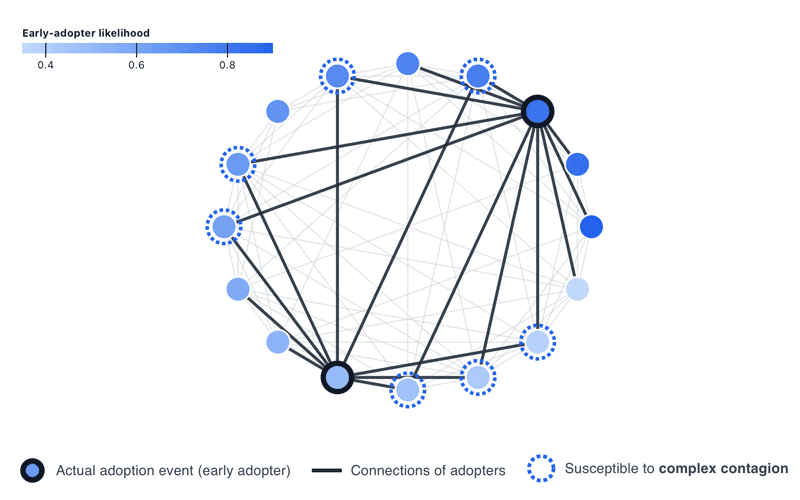
People who live close by, look alike, and think similarly are much more likely to be connected. “Friends of friends” often become friends. In this example, a tightly connected 16-person East Village circle shows very high "clustering" - meaning each hipster has many mutual friends. Note how many nodes are exposed to both initial adopters.
Why Trends Might Still Fizzle in Dense Networks
Dense, tight-knit communities create the potential for trends to catch on. High clustering means you often encounter the same idea multiple times—through a friend, and a friend’s friend—making complex contagion possible.
But there’s still a missing ingredient.
Even with repeated exposures, an idea or behavior still needs to be noticed and remembered to actually spread. Just like a disease must be infectious enough to jump from person to person, a trend needs to stand out, be memorable, or feel relevant before people adopt it—even when they’ve seen it more than once.3
Stickiness
Why Some Ideas Spread
Not every new thing gets remembered. The concept of stickiness is about how much an idea, product, or look stands out—and how long people talk about it after seeing it. Hush Puppies were so out of place that when someone saw them, they remembered, talked, and thought about them again. In our model, stickier ideas spread more easily, even if people need multiple exposures.
3
Stickiness in Action: Not Everyone Adopts
Dense community structure enables complex contagion by providing multiple exposures, but stickiness determines whether an idea is noticed and remembered.
In our model, two early adopters could spread the idea to a non-adopter via two links with different stickiness probabilities (shown). Adoption requires a minimum threshold to be met.
The top network has low stickiness (0.2), resulting in a 4% chance of adoption.
The bottom network has high stickiness (0.8), resulting in a 64%chance of adoption
The Echo Chamber: Success in a Bubble
With initial adopters, a tight-knit community, and a sticky idea, a trend can completely saturate its local group. This creates an "echo chamber" where the idea seems universally popular.
But this local success often hits an invisible wall, failing to spread to the wider world. But there’s still a missing ingredient.
4
Connectors
Bridges Between Worlds
Some people aren’t just well connected—they bridge groups. These connectors link the hipsters to the fashion world, letting the trend jump into new circles. In our model, connectors are the “wide bridge” that allows the epidemic to escape its original community.
4
Connectors: The Missing Links
A trend can catch fire inside a dense community, but to leap farther it needs connectors, people embedded in multiple circles. Hipster adopters (black ring) make those connectors susceptible, ready to ferry the idea to Fashion Leaders.
From Steady Spread to Sudden Surge
Connectors play a critical role in moving an idea beyond its birthplace. With their help, social contagion spreads steadily, turning isolated bubbles into a broader current. But as powerful as connectors are, this kind of spread is often gradual, more like a slow burn than a wildfire. To trigger a true tipping point, a sudden, explosive surge in adoption, one more vital ingredient is needed.
5
Influencers
Reaching the Masses
At the tipping point, influencers (like fashion leaders) with huge reach can broadcast trends far and wide. In our model, they’re highly connected nodes (think about a "hub" node with many "spoke" links) who can rapidly spread an idea to regular people, turning a local fad into a full-blown epidemic.
5
Influencers:
At the Tipping PointA small core of fashion leaders (center) not only reinforce each other within their own community but also cast a wide net into the wider public. As the general public is repeatedly exposed to fashion leaders wearing hush puppies, or using them on runways, many of them may choose to adopt the behavior.
From this point on, it is also helpful to think about patterns that repeat themselves. The influencers may spread a product or idea into multiple dense communities, at which point the product can spread within these communities, before the connectors in these communities bridge the product yet further into new communities.
Ingredients for a
Tipping Point:Early Adopters
Community Structure
Stickiness
Connectors
Influencers
Bummer! Our simulator works on desktop size devices only.
Please come back on a larger size device!What are the catalysts for a trend's explosion?
Complex contagion theory is when adopting a new product
or behavior takes multiple exposures — not just one.Tipping Points
In the early 2000s, Malcolm Gladwell’s book The Tipping Point described what catalyzes a trend taking off. Today, we are not only able to describe trends, but apply data to forecast how likely it is for a product to become the next big thing.
An Example from
The Tipping PointIn the Hush Puppies story, shoes didn’t spread instantly: it took seeing them again and again, within tight social circles, before people caught on.
We’ll walk through the key social ingredients Malcolm Gladwell says are needed for an “epidemic” like this to happen—and show how changing each ingredient impacts adoption to make the produce take off or fizzle out.
1
Early
AdoptersSome people are especially tuned in to what’s new or different, and willing to give it a try. In our model, they’re more likely to be the first adopters. In the Hush Puppies story, these were East Village hipsters who tried something weird, making it just a little less weird for everyone else.
1
Early Adopters: Necessary but Not Sufficient
In this example, the darker the node, the higher likelihood of being early adopters, while the thick black circles show actual early adoption happening. Bold black edges show connections of the initial adopters. Note no node is exposed to multiple initial adopters.
Why Trends Often Fizzle in Sparse Networks
When a network is random and connections are sparse, even having early adopters isn’t enough to ignite widespread change. Most people won’t encounter the new idea from more than one neighbor, so the social “push” needed for complex contagion just doesn’t happen. Most trends stall with a handful of adopters—it’s rare for an idea to get enough multiple exposures to catch on more broadly.
2
Community Structure
Where Trends Are Born
Trends don’t start everywhere—they start in tight communities where people are closely connected. In 1994, it was young NYC hipsters in the East Village who noticed the odd, forgotten Hush Puppies shoes and began wearing them. Their dense network meant the style had the potential to quickly “bounce around” within the group.
2
Community Structure: Social Graph of Young NYC Hipsters
People who live close by, look alike, and think similarly are much more likely to be connected. “Friends of friends” often become friends. In this example, a tightly connected 16-person East Village circle shows very high "clustering" - meaning each hipster has many mutual friends. Note how many nodes are exposed to both initial adopters.
Why Trends Might Still Fizzle in Dense Networks
Dense, tight-knit communities create the potential for trends to catch on. High clustering means you often encounter the same idea multiple times—through a friend, and a friend’s friend—making complex contagion possible.
But there’s still a missing ingredient.
Even with repeated exposures, an idea or behavior still needs to be noticed and remembered to actually spread. Just like a disease must be infectious enough to jump from person to person, a trend needs to stand out, be memorable, or feel relevant before people adopt it—even when they’ve seen it more than once.3
Stickiness
Why Some Ideas Spread
Not every new thing gets remembered. The concept of stickiness is about how much an idea, product, or look stands out—and how long people talk about it after seeing it. Hush Puppies were so out of place that when someone saw them, they remembered, talked, and thought about them again. In our model, stickier ideas spread more easily, even if people need multiple exposures.
3
Stickiness in Action: Not Everyone Adopts
Dense community structure enables complex contagion by providing multiple exposures, but stickiness determines whether an idea is noticed and remembered.
In our model, two early adopters could spread the idea to a non-adopter via two links with different stickiness probabilities (shown). Adoption requires a minimum threshold to be met.
The top network has low stickiness (0.2), resulting in a 4% chance of adoption.
The bottom network has high stickiness (0.8), resulting in a 64%chance of adoption
The Echo Chamber: Success in a Bubble
With initial adopters, a tight-knit community, and a sticky idea, a trend can completely saturate its local group. This creates an "echo chamber" where the idea seems universally popular.
But this local success often hits an invisible wall, failing to spread to the wider world. But there’s still a missing ingredient.
4
Connectors
Bridges Between Worlds
Some people aren’t just well connected—they bridge groups. These connectors link the hipsters to the fashion world, letting the trend jump into new circles. In our model, connectors are the “wide bridge” that allows the epidemic to escape its original community.
4
Connectors: The Missing Links
A trend can catch fire inside a dense community, but to leap farther it needs connectors, people embedded in multiple circles. Hipster adopters (black ring) make those connectors susceptible, ready to ferry the idea to Fashion Leaders.
From Steady Spread to Sudden Surge
Connectors play a critical role in moving an idea beyond its birthplace. With their help, social contagion spreads steadily, turning isolated bubbles into a broader current. But as powerful as connectors are, this kind of spread is often gradual, more like a slow burn than a wildfire. To trigger a true tipping point, a sudden, explosive surge in adoption, one more vital ingredient is needed.
5
Influencers
Reaching the Masses
At the tipping point, influencers (like fashion leaders) with huge reach can broadcast trends far and wide. In our model, they’re highly connected nodes (think about a "hub" node with many "spoke" links) who can rapidly spread an idea to regular people, turning a local fad into a full-blown epidemic.
5
Influencers:
At the Tipping PointA small core of fashion leaders (center) not only reinforce each other within their own community but also cast a wide net into the wider public. As the general public is repeatedly exposed to fashion leaders wearing hush puppies, or using them on runways, many of them may choose to adopt the behavior.
From this point on, it is also helpful to think about patterns that repeat themselves. The influencers may spread a product or idea into multiple dense communities, at which point the product can spread within these communities, before the connectors in these communities bridge the product yet further into new communities.
Ingredients for a
Tipping Point:Early Adopters
Community Structure
Stickiness
Connectors
Influencers
Bummer! Our simulator works on desktop size devices only.
Please come back on a larger size device!What are the catalysts for a trend's explosion?
Complex contagion theory is when adopting a new product
or behavior takes multiple exposures — not just one.Tipping Points
In the early 2000s, Malcolm Gladwell’s book The Tipping Point described what catalyzes a trend taking off. Today, we are not only able to describe trends, but apply data to forecast how likely it is for a product to become the next big thing.
An Example from
The Tipping PointIn the Hush Puppies story, shoes didn’t spread instantly: it took seeing them again and again, within tight social circles, before people caught on.
We’ll walk through the key social ingredients Malcolm Gladwell says are needed for an “epidemic” like this to happen—and show how changing each ingredient impacts adoption to make the produce take off or fizzle out.
1
Early
AdoptersSome people are especially tuned in to what’s new or different, and willing to give it a try. In our model, they’re more likely to be the first adopters. In the Hush Puppies story, these were East Village hipsters who tried something weird, making it just a little less weird for everyone else.
1
Early Adopters: Necessary but Not Sufficient
In this example, the darker the node, the higher likelihood of being early adopters, while the thick black circles show actual early adoption happening. Bold black edges show connections of the initial adopters. Note no node is exposed to multiple initial adopters.
Why Trends Often Fizzle in Sparse Networks
When a network is random and connections are sparse, even having early adopters isn’t enough to ignite widespread change. Most people won’t encounter the new idea from more than one neighbor, so the social “push” needed for complex contagion just doesn’t happen. Most trends stall with a handful of adopters—it’s rare for an idea to get enough multiple exposures to catch on more broadly.
2
Community Structure
Where Trends Are Born
Trends don’t start everywhere—they start in tight communities where people are closely connected. In 1994, it was young NYC hipsters in the East Village who noticed the odd, forgotten Hush Puppies shoes and began wearing them. Their dense network meant the style had the potential to quickly “bounce around” within the group.
2
Community Structure: Social Graph of Young NYC Hipsters
People who live close by, look alike, and think similarly are much more likely to be connected. “Friends of friends” often become friends. In this example, a tightly connected 16-person East Village circle shows very high "clustering" - meaning each hipster has many mutual friends. Note how many nodes are exposed to both initial adopters.
Why Trends Might Still Fizzle in Dense Networks
Dense, tight-knit communities create the potential for trends to catch on. High clustering means you often encounter the same idea multiple times—through a friend, and a friend’s friend—making complex contagion possible.
But there’s still a missing ingredient.
Even with repeated exposures, an idea or behavior still needs to be noticed and remembered to actually spread. Just like a disease must be infectious enough to jump from person to person, a trend needs to stand out, be memorable, or feel relevant before people adopt it—even when they’ve seen it more than once.3
Stickiness
Why Some Ideas Spread
Not every new thing gets remembered. The concept of stickiness is about how much an idea, product, or look stands out—and how long people talk about it after seeing it. Hush Puppies were so out of place that when someone saw them, they remembered, talked, and thought about them again. In our model, stickier ideas spread more easily, even if people need multiple exposures.
3
Stickiness in Action: Not Everyone Adopts
Dense community structure enables complex contagion by providing multiple exposures, but stickiness determines whether an idea is noticed and remembered.
In our model, two early adopters could spread the idea to a non-adopter via two links with different stickiness probabilities (shown). Adoption requires a minimum threshold to be met.
The top network has low stickiness (0.2), resulting in a 4% chance of adoption.
The bottom network has high stickiness (0.8), resulting in a 64%chance of adoption
The Echo Chamber: Success in a Bubble
With initial adopters, a tight-knit community, and a sticky idea, a trend can completely saturate its local group. This creates an "echo chamber" where the idea seems universally popular.
But this local success often hits an invisible wall, failing to spread to the wider world. But there’s still a missing ingredient.
4
Connectors
Bridges Between Worlds
Some people aren’t just well connected—they bridge groups. These connectors link the hipsters to the fashion world, letting the trend jump into new circles. In our model, connectors are the “wide bridge” that allows the epidemic to escape its original community.
4
Connectors: The Missing Links
A trend can catch fire inside a dense community, but to leap farther it needs connectors, people embedded in multiple circles. Hipster adopters (black ring) make those connectors susceptible, ready to ferry the idea to Fashion Leaders.
From Steady Spread to Sudden Surge
Connectors play a critical role in moving an idea beyond its birthplace. With their help, social contagion spreads steadily, turning isolated bubbles into a broader current. But as powerful as connectors are, this kind of spread is often gradual, more like a slow burn than a wildfire. To trigger a true tipping point, a sudden, explosive surge in adoption, one more vital ingredient is needed.
5
Influencers
Reaching the Masses
At the tipping point, influencers (like fashion leaders) with huge reach can broadcast trends far and wide. In our model, they’re highly connected nodes (think about a "hub" node with many "spoke" links) who can rapidly spread an idea to regular people, turning a local fad into a full-blown epidemic.
5
Influencers:
At the Tipping PointA small core of fashion leaders (center) not only reinforce each other within their own community but also cast a wide net into the wider public. As the general public is repeatedly exposed to fashion leaders wearing hush puppies, or using them on runways, many of them may choose to adopt the behavior.
From this point on, it is also helpful to think about patterns that repeat themselves. The influencers may spread a product or idea into multiple dense communities, at which point the product can spread within these communities, before the connectors in these communities bridge the product yet further into new communities.
Ingredients for a
Tipping Point:Early Adopters
Community Structure
Stickiness
Connectors
Influencers
Bummer! Our simulator works on desktop size devices only.
Please come back on a larger size device!What are the catalysts for a trend's explosion?
Complex contagion theory is when adopting a new product
or behavior takes multiple exposures — not just one.Tipping Points
In the early 2000s, Malcolm Gladwell’s book The Tipping Point described what catalyzes a trend taking off. Today, we are not only able to describe trends, but apply data to forecast how likely it is for a product to become the next big thing.
An Example from
The Tipping PointIn the Hush Puppies story, shoes didn’t spread instantly: it took seeing them again and again, within tight social circles, before people caught on.
We’ll walk through the key social ingredients Malcolm Gladwell says are needed for an “epidemic” like this to happen—and show how changing each ingredient impacts adoption to make the produce take off or fizzle out.
1
Early
AdoptersSome people are especially tuned in to what’s new or different, and willing to give it a try. In our model, they’re more likely to be the first adopters. In the Hush Puppies story, these were East Village hipsters who tried something weird, making it just a little less weird for everyone else.
1
Early Adopters: Necessary but Not Sufficient
In this example, the darker the node, the higher likelihood of being early adopters, while the thick black circles show actual early adoption happening. Bold black edges show connections of the initial adopters. Note no node is exposed to multiple initial adopters.
Why Trends Often Fizzle in Sparse Networks
When a network is random and connections are sparse, even having early adopters isn’t enough to ignite widespread change. Most people won’t encounter the new idea from more than one neighbor, so the social “push” needed for complex contagion just doesn’t happen. Most trends stall with a handful of adopters—it’s rare for an idea to get enough multiple exposures to catch on more broadly.
2
Community Structure
Where Trends Are Born
Trends don’t start everywhere—they start in tight communities where people are closely connected. In 1994, it was young NYC hipsters in the East Village who noticed the odd, forgotten Hush Puppies shoes and began wearing them. Their dense network meant the style had the potential to quickly “bounce around” within the group.
2
Community Structure: Social Graph of Young NYC Hipsters
People who live close by, look alike, and think similarly are much more likely to be connected. “Friends of friends” often become friends. In this example, a tightly connected 16-person East Village circle shows very high "clustering" - meaning each hipster has many mutual friends. Note how many nodes are exposed to both initial adopters.
Why Trends Might Still Fizzle in Dense Networks
Dense, tight-knit communities create the potential for trends to catch on. High clustering means you often encounter the same idea multiple times—through a friend, and a friend’s friend—making complex contagion possible.
But there’s still a missing ingredient.
Even with repeated exposures, an idea or behavior still needs to be noticed and remembered to actually spread. Just like a disease must be infectious enough to jump from person to person, a trend needs to stand out, be memorable, or feel relevant before people adopt it—even when they’ve seen it more than once.3
Stickiness
Why Some Ideas Spread
Not every new thing gets remembered. The concept of stickiness is about how much an idea, product, or look stands out—and how long people talk about it after seeing it. Hush Puppies were so out of place that when someone saw them, they remembered, talked, and thought about them again. In our model, stickier ideas spread more easily, even if people need multiple exposures.
3
Stickiness in Action: Not Everyone Adopts
Dense community structure enables complex contagion by providing multiple exposures, but stickiness determines whether an idea is noticed and remembered.
In our model, two early adopters could spread the idea to a non-adopter via two links with different stickiness probabilities (shown). Adoption requires a minimum threshold to be met.
The top network has low stickiness (0.2), resulting in a 4% chance of adoption.
The bottom network has high stickiness (0.8), resulting in a 64%chance of adoption
The Echo Chamber: Success in a Bubble
With initial adopters, a tight-knit community, and a sticky idea, a trend can completely saturate its local group. This creates an "echo chamber" where the idea seems universally popular.
But this local success often hits an invisible wall, failing to spread to the wider world. But there’s still a missing ingredient.
4
Connectors
Bridges Between Worlds
Some people aren’t just well connected—they bridge groups. These connectors link the hipsters to the fashion world, letting the trend jump into new circles. In our model, connectors are the “wide bridge” that allows the epidemic to escape its original community.
4
Connectors: The Missing Links
A trend can catch fire inside a dense community, but to leap farther it needs connectors, people embedded in multiple circles. Hipster adopters (black ring) make those connectors susceptible, ready to ferry the idea to Fashion Leaders.
From Steady Spread to Sudden Surge
Connectors play a critical role in moving an idea beyond its birthplace. With their help, social contagion spreads steadily, turning isolated bubbles into a broader current. But as powerful as connectors are, this kind of spread is often gradual, more like a slow burn than a wildfire. To trigger a true tipping point, a sudden, explosive surge in adoption, one more vital ingredient is needed.
5
Influencers
Reaching the Masses
At the tipping point, influencers (like fashion leaders) with huge reach can broadcast trends far and wide. In our model, they’re highly connected nodes (think about a "hub" node with many "spoke" links) who can rapidly spread an idea to regular people, turning a local fad into a full-blown epidemic.
5
Influencers:
At the Tipping PointA small core of fashion leaders (center) not only reinforce each other within their own community but also cast a wide net into the wider public. As the general public is repeatedly exposed to fashion leaders wearing hush puppies, or using them on runways, many of them may choose to adopt the behavior.
From this point on, it is also helpful to think about patterns that repeat themselves. The influencers may spread a product or idea into multiple dense communities, at which point the product can spread within these communities, before the connectors in these communities bridge the product yet further into new communities.
Ingredients for a
Tipping Point:Early Adopters
Community Structure
Stickiness
Connectors
Influencers
Bummer! Our simulator works on desktop size devices only.
Please come back on a larger size device!
What makes a trend suddenly take off?
Complex contagion theory is when adopting a new product
or behavior takes multiple exposures — not just one.Tipping Points
In the early 2000s, Malcolm Gladwell’s book
The Tipping Point described what catalyzes a trend taking off. Today, we are not only able to describe trends, but apply data to forecast how likely it is for a product to become the next big thing.An Example from The Tipping Point
In the Hush Puppies story, shoes didn’t spread instantly: it took seeing them again and again, within tight social circles, before people caught on.
We’ll walk through the key social ingredients Malcolm Gladwell says are needed for an “epidemic” like this to happen—and show how changing each ingredient impacts adoption to make the produce take off or fizzle out.
1
Early
AdoptersSome people are especially tuned in to what’s new or different, and willing to give it a try. In our model, they’re more likely to be the first adopters. In the Hush Puppies story, these were East Village hipsters who tried something weird, making it just a little less weird for everyone else.
1
Early Adopters: Necessary but Not Sufficient
In this example, the darker the node, the higher likelihood of being early adopters, while the thick black circles show actual early adoption happening. Bold black edges show connections of the initial adopters. Note no node is exposed to multiple initial adopters.
Why Trends Often Fizzle in Sparse Networks
When a network is random and connections are sparse, even having early adopters isn’t enough to ignite widespread change. Most people won’t encounter the new idea from more than one neighbor, so the social “push” needed for complex contagion just doesn’t happen. Most trends stall with a handful of adopters—it’s rare for an idea to get enough multiple exposures to catch on more broadly.
2
Community Structure
Where Trends Are Born
Trends don’t start everywhere—they start in tight communities where people are closely connected. In 1994, it was young NYC hipsters in the East Village who noticed the odd, forgotten Hush Puppies shoes and began wearing them. Their dense network meant the style had the potential to quickly “bounce around” within the group.
2
Community Structure: Social Graph of Young NYC Hipsters
People who live close by, look alike, and think similarly are much more likely to be connected. “Friends of friends” often become friends. In this example, a tightly connected 16-person East Village circle shows very high "clustering" - meaning each hipster has many mutual friends. Note how many nodes are exposed to both initial adopters.
Why Trends Might Still Fizzle in Dense Networks
Dense, tight-knit communities create the potential for trends to catch on. High clustering means you often encounter the same idea multiple times—through a friend, and a friend’s friend—making complex contagion possible.
But there’s still a missing ingredient.
Even with repeated exposures, an idea or behavior still needs to be noticed and remembered to actually spread. Just like a disease must be infectious enough to jump from person to person, a trend needs to stand out, be memorable, or feel relevant before people adopt it—even when they’ve seen it more than once.3
Stickiness
Why Some Ideas Spread
Not every new thing gets remembered. The concept of stickiness is about how much an idea, product, or look stands out—and how long people talk about it after seeing it. Hush Puppies were so out of place that when someone saw them, they remembered, talked, and thought about them again. In our model, stickier ideas spread more easily, even if people need multiple exposures.
3
Stickiness in Action: Not Everyone Adopts
Dense community structure enables complex contagion by providing multiple exposures, but stickiness determines whether an idea is noticed and remembered.
In our model, two early adopters could spread the idea to a non-adopter via two links with different stickiness probabilities (shown). Adoption requires a minimum threshold to be met.
The top network has low stickiness (0.2), resulting in a 4% chance of adoption.
The bottom network has high stickiness (0.8), resulting in a 64%chance of adoption
The Echo Chamber: Success in a Bubble
With initial adopters, a tight-knit community, and a sticky idea, a trend can completely saturate its local group. This creates an "echo chamber" where the idea seems universally popular.
But this local success often hits an invisible wall, failing to spread to the wider world. But there’s still a missing ingredient.
4
Connectors
Bridges Between Worlds
Some people aren’t just well connected—they bridge groups. These connectors link the hipsters to the fashion world, letting the trend jump into new circles. In our model, connectors are the “wide bridge” that allows the epidemic to escape its original community.
4
Connectors: The Missing Links
A trend can catch fire inside a dense community, but to leap farther it needs connectors, people embedded in multiple circles. Hipster adopters (black ring) make those connectors susceptible, ready to ferry the idea to Fashion Leaders.
From Steady Spread to Sudden Surge
Connectors play a critical role in moving an idea beyond its birthplace. With their help, social contagion spreads steadily, turning isolated bubbles into a broader current. But as powerful as connectors are, this kind of spread is often gradual, more like a slow burn than a wildfire. To trigger a true tipping point, a sudden, explosive surge in adoption, one more vital ingredient is needed.
5
Influencers
Reaching the Masses
At the tipping point, influencers (like fashion leaders) with huge reach can broadcast trends far and wide. In our model, they’re highly connected nodes (think about a "hub" node with many "spoke" links) who can rapidly spread an idea to regular people, turning a local fad into a full-blown epidemic.
5
Influencers: At the Tipping Point
A small core of fashion leaders (center) not only reinforce each other within their own community but also cast a wide net into the wider public. As the general public is repeatedly exposed to fashion leaders wearing hush puppies, or using them on runways, many of them may choose to adopt the behavior.
From this point on, it is also helpful to think about patterns that repeat themselves. The influencers may spread a product or idea into multiple dense communities, at which point the product can spread within these communities, before the connectors in these communities bridge the product yet further into new communities.
Ingredients for a
Tipping Point:Early Adopters
Community Structure
Stickiness
Connectors
Influencers
What makes a trend suddenly take off?
Complex contagion theory is when adopting a new product
or behavior takes multiple exposures — not just one.Tipping Points
In the early 2000s, Malcolm Gladwell’s book
The Tipping Point described what catalyzes a trend taking off. Today, we are not only able to describe trends, but apply data to forecast how likely it is for a product to become the next big thing.An Example from The Tipping Point
In the Hush Puppies story, shoes didn’t spread instantly: it took seeing them again and again, within tight social circles, before people caught on.
We’ll walk through the key social ingredients Malcolm Gladwell says are needed for an “epidemic” like this to happen—and show how changing each ingredient impacts adoption to make the produce take off or fizzle out.
1
Early
AdoptersSome people are especially tuned in to what’s new or different, and willing to give it a try. In our model, they’re more likely to be the first adopters. In the Hush Puppies story, these were East Village hipsters who tried something weird, making it just a little less weird for everyone else.
1
Early Adopters: Necessary but Not Sufficient
In this example, the darker the node, the higher likelihood of being early adopters, while the thick black circles show actual early adoption happening. Bold black edges show connections of the initial adopters. Note no node is exposed to multiple initial adopters.
Why Trends Often Fizzle in Sparse Networks
When a network is random and connections are sparse, even having early adopters isn’t enough to ignite widespread change. Most people won’t encounter the new idea from more than one neighbor, so the social “push” needed for complex contagion just doesn’t happen. Most trends stall with a handful of adopters—it’s rare for an idea to get enough multiple exposures to catch on more broadly.
2
Community Structure
Where Trends Are Born
Trends don’t start everywhere—they start in tight communities where people are closely connected. In 1994, it was young NYC hipsters in the East Village who noticed the odd, forgotten Hush Puppies shoes and began wearing them. Their dense network meant the style had the potential to quickly “bounce around” within the group.
2
Community Structure: Social Graph of Young NYC Hipsters
People who live close by, look alike, and think similarly are much more likely to be connected. “Friends of friends” often become friends. In this example, a tightly connected 16-person East Village circle shows very high "clustering" - meaning each hipster has many mutual friends. Note how many nodes are exposed to both initial adopters.
Why Trends Might Still Fizzle in Dense Networks
Dense, tight-knit communities create the potential for trends to catch on. High clustering means you often encounter the same idea multiple times—through a friend, and a friend’s friend—making complex contagion possible.
But there’s still a missing ingredient.
Even with repeated exposures, an idea or behavior still needs to be noticed and remembered to actually spread. Just like a disease must be infectious enough to jump from person to person, a trend needs to stand out, be memorable, or feel relevant before people adopt it—even when they’ve seen it more than once.3
Stickiness
Why Some Ideas Spread
Not every new thing gets remembered. The concept of stickiness is about how much an idea, product, or look stands out—and how long people talk about it after seeing it. Hush Puppies were so out of place that when someone saw them, they remembered, talked, and thought about them again. In our model, stickier ideas spread more easily, even if people need multiple exposures.
3
Stickiness in Action: Not Everyone Adopts
Dense community structure enables complex contagion by providing multiple exposures, but stickiness determines whether an idea is noticed and remembered.
In our model, two early adopters could spread the idea to a non-adopter via two links with different stickiness probabilities (shown). Adoption requires a minimum threshold to be met.
The top network has low stickiness (0.2), resulting in a 4% chance of adoption.
The bottom network has high stickiness (0.8), resulting in a 64%chance of adoption
The Echo Chamber: Success in a Bubble
With initial adopters, a tight-knit community, and a sticky idea, a trend can completely saturate its local group. This creates an "echo chamber" where the idea seems universally popular.
But this local success often hits an invisible wall, failing to spread to the wider world. But there’s still a missing ingredient.
4
Connectors
Bridges Between Worlds
Some people aren’t just well connected—they bridge groups. These connectors link the hipsters to the fashion world, letting the trend jump into new circles. In our model, connectors are the “wide bridge” that allows the epidemic to escape its original community.
4
Connectors: The Missing Links
A trend can catch fire inside a dense community, but to leap farther it needs connectors, people embedded in multiple circles. Hipster adopters (black ring) make those connectors susceptible, ready to ferry the idea to Fashion Leaders.
From Steady Spread to Sudden Surge
Connectors play a critical role in moving an idea beyond its birthplace. With their help, social contagion spreads steadily, turning isolated bubbles into a broader current. But as powerful as connectors are, this kind of spread is often gradual, more like a slow burn than a wildfire. To trigger a true tipping point, a sudden, explosive surge in adoption, one more vital ingredient is needed.
5
Influencers
Reaching the Masses
At the tipping point, influencers (like fashion leaders) with huge reach can broadcast trends far and wide. In our model, they’re highly connected nodes (think about a "hub" node with many "spoke" links) who can rapidly spread an idea to regular people, turning a local fad into a full-blown epidemic.
5
Influencers: At the Tipping Point
A small core of fashion leaders (center) not only reinforce each other within their own community but also cast a wide net into the wider public. As the general public is repeatedly exposed to fashion leaders wearing hush puppies, or using them on runways, many of them may choose to adopt the behavior.
From this point on, it is also helpful to think about patterns that repeat themselves. The influencers may spread a product or idea into multiple dense communities, at which point the product can spread within these communities, before the connectors in these communities bridge the product yet further into new communities.
Ingredients for a
Tipping Point:Early Adopters
Community Structure
Stickiness
Connectors
Influencers
What makes a trend suddenly take off?
Complex contagion theory is when adopting a new product
or behavior takes multiple exposures — not just one.Tipping Points
In the early 2000s, Malcolm Gladwell’s book
The Tipping Point described what catalyzes a trend taking off. Today, we are not only able to describe trends, but apply data to forecast how likely it is for a product to become the next big thing.An Example from The Tipping Point
In the Hush Puppies story, shoes didn’t spread instantly: it took seeing them again and again, within tight social circles, before people caught on.
We’ll walk through the key social ingredients Malcolm Gladwell says are needed for an “epidemic” like this to happen—and show how changing each ingredient impacts adoption to make the produce take off or fizzle out.
1
Early
AdoptersSome people are especially tuned in to what’s new or different, and willing to give it a try. In our model, they’re more likely to be the first adopters. In the Hush Puppies story, these were East Village hipsters who tried something weird, making it just a little less weird for everyone else.
1
Early Adopters: Necessary but Not Sufficient
In this example, the darker the node, the higher likelihood of being early adopters, while the thick black circles show actual early adoption happening. Bold black edges show connections of the initial adopters. Note no node is exposed to multiple initial adopters.
Why Trends Often Fizzle in Sparse Networks
When a network is random and connections are sparse, even having early adopters isn’t enough to ignite widespread change. Most people won’t encounter the new idea from more than one neighbor, so the social “push” needed for complex contagion just doesn’t happen. Most trends stall with a handful of adopters—it’s rare for an idea to get enough multiple exposures to catch on more broadly.
2
Community Structure
Where Trends Are Born
Trends don’t start everywhere—they start in tight communities where people are closely connected. In 1994, it was young NYC hipsters in the East Village who noticed the odd, forgotten Hush Puppies shoes and began wearing them. Their dense network meant the style had the potential to quickly “bounce around” within the group.
2
Community Structure: Social Graph of Young NYC Hipsters
People who live close by, look alike, and think similarly are much more likely to be connected. “Friends of friends” often become friends. In this example, a tightly connected 16-person East Village circle shows very high "clustering" - meaning each hipster has many mutual friends. Note how many nodes are exposed to both initial adopters.
Why Trends Might Still Fizzle in Dense Networks
Dense, tight-knit communities create the potential for trends to catch on. High clustering means you often encounter the same idea multiple times—through a friend, and a friend’s friend—making complex contagion possible.
But there’s still a missing ingredient.
Even with repeated exposures, an idea or behavior still needs to be noticed and remembered to actually spread. Just like a disease must be infectious enough to jump from person to person, a trend needs to stand out, be memorable, or feel relevant before people adopt it—even when they’ve seen it more than once.3
Stickiness
Why Some Ideas Spread
Not every new thing gets remembered. The concept of stickiness is about how much an idea, product, or look stands out—and how long people talk about it after seeing it. Hush Puppies were so out of place that when someone saw them, they remembered, talked, and thought about them again. In our model, stickier ideas spread more easily, even if people need multiple exposures.
3
Stickiness in Action: Not Everyone Adopts
Dense community structure enables complex contagion by providing multiple exposures, but stickiness determines whether an idea is noticed and remembered.
In our model, two early adopters could spread the idea to a non-adopter via two links with different stickiness probabilities (shown). Adoption requires a minimum threshold to be met.
The top network has low stickiness (0.2), resulting in a 4% chance of adoption.
The bottom network has high stickiness (0.8), resulting in a 64%chance of adoption
The Echo Chamber: Success in a Bubble
With initial adopters, a tight-knit community, and a sticky idea, a trend can completely saturate its local group. This creates an "echo chamber" where the idea seems universally popular.
But this local success often hits an invisible wall, failing to spread to the wider world. But there’s still a missing ingredient.
4
Connectors
Bridges Between Worlds
Some people aren’t just well connected—they bridge groups. These connectors link the hipsters to the fashion world, letting the trend jump into new circles. In our model, connectors are the “wide bridge” that allows the epidemic to escape its original community.
4
Connectors: The Missing Links
A trend can catch fire inside a dense community, but to leap farther it needs connectors, people embedded in multiple circles. Hipster adopters (black ring) make those connectors susceptible, ready to ferry the idea to Fashion Leaders.
From Steady Spread to Sudden Surge
Connectors play a critical role in moving an idea beyond its birthplace. With their help, social contagion spreads steadily, turning isolated bubbles into a broader current. But as powerful as connectors are, this kind of spread is often gradual, more like a slow burn than a wildfire. To trigger a true tipping point, a sudden, explosive surge in adoption, one more vital ingredient is needed.
5
Influencers
Reaching the Masses
At the tipping point, influencers (like fashion leaders) with huge reach can broadcast trends far and wide. In our model, they’re highly connected nodes (think about a "hub" node with many "spoke" links) who can rapidly spread an idea to regular people, turning a local fad into a full-blown epidemic.
5
Influencers: At the Tipping Point
A small core of fashion leaders (center) not only reinforce each other within their own community but also cast a wide net into the wider public. As the general public is repeatedly exposed to fashion leaders wearing hush puppies, or using them on runways, many of them may choose to adopt the behavior.
From this point on, it is also helpful to think about patterns that repeat themselves. The influencers may spread a product or idea into multiple dense communities, at which point the product can spread within these communities, before the connectors in these communities bridge the product yet further into new communities.
Ingredients for a
Tipping Point:Early Adopters
Community Structure
Stickiness
Connectors
Influencers
What makes a trend suddenly take off?
Complex contagion theory is when adopting a new product
or behavior takes multiple exposures — not just one.Tipping Points
In the early 2000s, Malcolm Gladwell’s book
The Tipping Point described what catalyzes a trend taking off. Today, we are not only able to describe trends, but apply data to forecast how likely it is for a product to become the next big thing.An Example from The Tipping Point
In the Hush Puppies story, shoes didn’t spread instantly: it took seeing them again and again, within tight social circles, before people caught on.
We’ll walk through the key social ingredients Malcolm Gladwell says are needed for an “epidemic” like this to happen—and show how changing each ingredient impacts adoption to make the produce take off or fizzle out.
1
Early
AdoptersSome people are especially tuned in to what’s new or different, and willing to give it a try. In our model, they’re more likely to be the first adopters. In the Hush Puppies story, these were East Village hipsters who tried something weird, making it just a little less weird for everyone else.
1
Early Adopters: Necessary but Not Sufficient
In this example, the darker the node, the higher likelihood of being early adopters, while the thick black circles show actual early adoption happening. Bold black edges show connections of the initial adopters. Note no node is exposed to multiple initial adopters.
Why Trends Often Fizzle in Sparse Networks
When a network is random and connections are sparse, even having early adopters isn’t enough to ignite widespread change. Most people won’t encounter the new idea from more than one neighbor, so the social “push” needed for complex contagion just doesn’t happen. Most trends stall with a handful of adopters—it’s rare for an idea to get enough multiple exposures to catch on more broadly.
2
Community Structure
Where Trends Are Born
Trends don’t start everywhere—they start in tight communities where people are closely connected. In 1994, it was young NYC hipsters in the East Village who noticed the odd, forgotten Hush Puppies shoes and began wearing them. Their dense network meant the style had the potential to quickly “bounce around” within the group.
2
Community Structure: Social Graph of Young NYC Hipsters
People who live close by, look alike, and think similarly are much more likely to be connected. “Friends of friends” often become friends. In this example, a tightly connected 16-person East Village circle shows very high "clustering" - meaning each hipster has many mutual friends. Note how many nodes are exposed to both initial adopters.
Why Trends Might Still Fizzle in Dense Networks
Dense, tight-knit communities create the potential for trends to catch on. High clustering means you often encounter the same idea multiple times—through a friend, and a friend’s friend—making complex contagion possible.
But there’s still a missing ingredient.
Even with repeated exposures, an idea or behavior still needs to be noticed and remembered to actually spread. Just like a disease must be infectious enough to jump from person to person, a trend needs to stand out, be memorable, or feel relevant before people adopt it—even when they’ve seen it more than once.3
Stickiness
Why Some Ideas Spread
Not every new thing gets remembered. The concept of stickiness is about how much an idea, product, or look stands out—and how long people talk about it after seeing it. Hush Puppies were so out of place that when someone saw them, they remembered, talked, and thought about them again. In our model, stickier ideas spread more easily, even if people need multiple exposures.
3
Stickiness in Action: Not Everyone Adopts
Dense community structure enables complex contagion by providing multiple exposures, but stickiness determines whether an idea is noticed and remembered.
In our model, two early adopters could spread the idea to a non-adopter via two links with different stickiness probabilities (shown). Adoption requires a minimum threshold to be met.
The top network has low stickiness (0.2), resulting in a 4% chance of adoption.
The bottom network has high stickiness (0.8), resulting in a 64%chance of adoption
The Echo Chamber: Success in a Bubble
With initial adopters, a tight-knit community, and a sticky idea, a trend can completely saturate its local group. This creates an "echo chamber" where the idea seems universally popular.
But this local success often hits an invisible wall, failing to spread to the wider world. But there’s still a missing ingredient.
4
Connectors
Bridges Between Worlds
Some people aren’t just well connected—they bridge groups. These connectors link the hipsters to the fashion world, letting the trend jump into new circles. In our model, connectors are the “wide bridge” that allows the epidemic to escape its original community.
4
Connectors: The Missing Links
A trend can catch fire inside a dense community, but to leap farther it needs connectors, people embedded in multiple circles. Hipster adopters (black ring) make those connectors susceptible, ready to ferry the idea to Fashion Leaders.
From Steady Spread to Sudden Surge
Connectors play a critical role in moving an idea beyond its birthplace. With their help, social contagion spreads steadily, turning isolated bubbles into a broader current. But as powerful as connectors are, this kind of spread is often gradual, more like a slow burn than a wildfire. To trigger a true tipping point, a sudden, explosive surge in adoption, one more vital ingredient is needed.
5
Influencers
Reaching the Masses
At the tipping point, influencers (like fashion leaders) with huge reach can broadcast trends far and wide. In our model, they’re highly connected nodes (think about a "hub" node with many "spoke" links) who can rapidly spread an idea to regular people, turning a local fad into a full-blown epidemic.
5
Influencers: At the Tipping Point
A small core of fashion leaders (center) not only reinforce each other within their own community but also cast a wide net into the wider public. As the general public is repeatedly exposed to fashion leaders wearing hush puppies, or using them on runways, many of them may choose to adopt the behavior.
From this point on, it is also helpful to think about patterns that repeat themselves. The influencers may spread a product or idea into multiple dense communities, at which point the product can spread within these communities, before the connectors in these communities bridge the product yet further into new communities.
Ingredients for a
Tipping Point:Early Adopters
Community Structure
Stickiness
Connectors
Influencers